
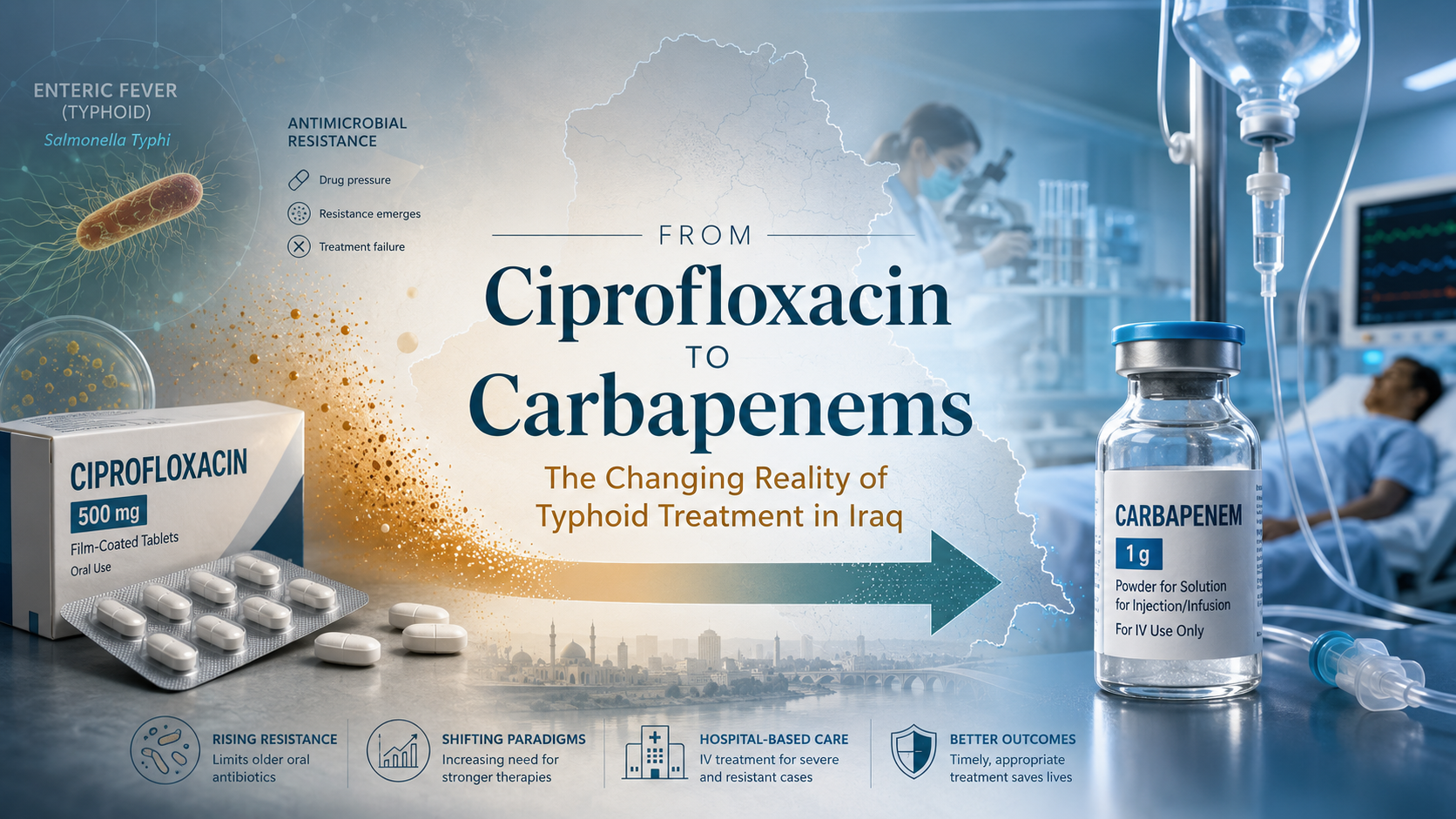
From Ciprofloxacin to Carbapenems: The Changing Reality of Typhoid Treatment in Iraq
Data Source: Multi-Center Clinical Data Audit, Najaf Governorate
Introduction
Antimicrobial resistance (AMR) is no longer solely a clinical concern; it has become a strategic healthcare challenge with significant implications for patient outcomes, healthcare costs, and resource utilization. Among the pathogens contributing to this burden, Salmonella Typhi and Salmonella Paratyphi, the causative agents of enteric fever, continue to pose a substantial public health challenge across Iraq.
To better understand local resistance patterns, a retrospective audit of microbiology laboratory data was conducted across four major hospitals in Najaf Governorate. The analysis covered the period from 2023 to early 2026 and included 320 laboratory-confirmed enteric fever cases. These isolates generated a total of 2,974 antimicrobial susceptibility test results, providing valuable insight into the current effectiveness of commonly used antibiotics and the evolving resistance landscape in the region.
Antibiotic Susceptibility Profile
The findings reveal substantial variation in susceptibility across antimicrobial classes and indicate increasing resistance to several antibiotics traditionally used for enteric fever treatment.
Declining Effectiveness of Traditional Oral Therapies
Ampicillin, once considered a cornerstone therapy for typhoid fever, demonstrated a resistance rate of 86.3% among tested isolates (n = 146), leaving only 13.7% susceptible. These findings suggest that ampicillin can no longer be considered a reliable empirical treatment option in this setting.
In contrast, several oral alternatives maintained favorable activity. Azithromycin showed an 86.5% susceptibility rate (n = 37), while trimethoprim-sulfamethoxazole demonstrated 70.5% susceptibility (n = 288). These agents may therefore remain reasonable options for selected mild-to-moderate cases managed in outpatient settings, provided that local susceptibility patterns continue to support their use.
The Fluoroquinolone Resistance Crisis
Fluoroquinolones, historically regarded as highly effective oral therapies for enteric fever, exhibited alarming levels of resistance.
Ciprofloxacin showed a resistance rate of 72.8% (n = 279), while an additional 22.2% of isolates demonstrated intermediate susceptibility, leaving only 5.0% fully susceptible. Similarly, levofloxacin exhibited a susceptibility rate of just 3.75% (n = 107), with 45.8% of isolates classified as intermediate.
These findings indicate that fluoroquinolones can no longer be relied upon as empirical first-line agents in many cases and may contribute to increased rates of treatment failure when prescribed without microbiological guidance.
Emerging Threats to Cephalosporin Therapy
Particularly concerning was the reduced effectiveness of third-generation cephalosporins, which remain among the most commonly used intravenous therapies for hospitalized patients.
Ceftriaxone demonstrated an 82.6% resistance rate (n = 161), with only 16.8% of isolates remaining susceptible. Similarly, cefotaxime exhibited an 83.2% resistance rate (n = 143). These findings suggest significant resistance pressure against this important antibiotic class and raise concerns regarding future therapeutic options.
Preservation of Carbapenem Activity
Despite widespread resistance to several frontline agents, carbapenems maintained excellent activity against the tested isolates.
- Meropenem: 99.5% susceptible (n = 209)
- Imipenem: 98.9% susceptible (n = 267)
These results indicate that carbapenems remain highly effective therapeutic options. However, their increasing use as rescue therapy may accelerate resistance development if antimicrobial stewardship measures are not strengthened.
Aminoglycosides: Interpreting High Laboratory Susceptibility with Caution
Amikacin and gentamicin demonstrated high in vitro activity, with susceptibility rates of 88.9% (n = 117) and 91.3% (n = 115), respectively.
However, these findings should be interpreted carefully. According to Clinical and Laboratory Standards Institute (CLSI) recommendations, aminoglycosides are not considered clinically appropriate therapeutic agents for enteric fever. Consequently, high laboratory susceptibility should not be interpreted as evidence supporting their clinical use for the treatment of Salmonella Typhi or Salmonella Paratyphi infections.
Susceptibility Rate Summary Table:
| Antibiotic | Susceptibility Rate | Tests No. (n) |
|---|---|---|
| Levofloxacin | 3.74% | 107 |
| Ciprofloxacin | 5.02% | 279 |
| Ampicillin | 13.70% | 146 |
| Cefotaxime | 15.38% | 143 |
| Ceftriaxone | 16.77% | 161 |
| Trimethoprim-Sulfamethoxazole | 70.50% | 288 |
| Azithromycin | 86.50% | 37 |
| Amikacin * | 88.90% | 117 |
| Gentamicin * | 91.30% | 115 |
| Imipenem | 98.88% | 267 |
| Meropenem | 99.50% | 209 |
*In-vitro activity only-Clinically not effective
Clinical and Public Health Implications
The observed susceptibility patterns highlight the importance of utilizing current local surveillance data when selecting empirical antimicrobial therapy. Reliance on historical prescribing practices may result in suboptimal clinical outcomes due to evolving resistance profiles.
Routine microbiological testing and antimicrobial susceptibility analysis remain essential for guiding treatment decisions, reducing therapeutic failures, and supporting antimicrobial stewardship programs.
From a public health perspective, continuous surveillance is critical for identifying emerging resistance trends before they become widespread. Data-driven prescribing practices can help preserve the effectiveness of existing antibiotics while minimizing selective pressure that accelerates resistance development.
Economic and Operational Impact
The consequences of antimicrobial resistance extend beyond clinical outcomes and impose substantial economic and operational burdens on healthcare systems.
Increased Treatment Costs
When relatively affordable agents such as ampicillin, ciprofloxacin, and ceftriaxone become ineffective, clinicians are often forced to escalate treatment to more expensive intravenous therapies such as carbapenems. This transition significantly increases direct medication costs per patient. In Iraq, where healthcare services are heavily subsidized, the government bears the largest share of this financial burden.
Hospital Resource Utilization
Treatment failure frequently necessitates hospitalization and prolonged intravenous therapy. As a result, hospital length of stay increases, acute-care beds remain occupied for longer periods, nursing workload rises, and healthcare resources become increasingly strained.
Patient Financial Burden
For many patients and families, empirical treatment failure leads to additional physician consultations, repeated laboratory investigations, and the purchase of costly broad-spectrum antibiotics from private pharmacies. These factors contribute to increased out-of-pocket expenditure and exacerbate the socioeconomic burden associated with enteric fever.
Conclusion
Analysis of antimicrobial susceptibility data from four hospitals in Najaf Governorate revealed substantial resistance among enteric fever isolates to several commonly used antibiotics, including ampicillin, ciprofloxacin, ceftriaxone, and cefotaxime.
While carbapenems retained excellent activity and certain oral alternatives such as azithromycin remained effective, the overall findings underscore the growing challenge posed by antimicrobial resistance in the region.
These results reinforce the need for continuous local surveillance, evidence-based antimicrobial selection, and strengthened stewardship programs. The Najaf dataset serves as a clear reminder that combating antimicrobial resistance requires ongoing investment in data collection, laboratory capacity, and informed clinical decision-making to preserve the effectiveness of available therapeutic options for future generations.
At Nippur, we believe that transforming clinical data into actionable insights is essential for strengthening healthcare systems, improving patient outcomes, and supporting sustainable healthcare planning. Studies, such as this, highlight the value of structured data analysis in bridging the gap between laboratory findings and strategic healthcare decisions.
هل تحتاج إلى دعم فني أو استشارات جودة؟
استكشف خدمات نيبور الاستشارية الدوائية وبرامج أكاديمية نيبور التدريبية المصممة للمصانع الدوائية وفرق الجودة.
تواصل مع خبرائنااشترك في نشرتنا البريدية
احصل على أحدث المقالات والتحديثات مباشرة في بريدك الإلكتروني.