Artificial Intelligence in Pharmaceutical Quality
Artificial intelligence is becoming an important part of the pharmaceutical industry, extending well beyond drug discovery and research. Today, AI is increasingly being explored across Quality Assurance (QA), Quality Control (QC), manufacturing, compliance, and operational decision-making.
For pharmaceutical companies, the opportunity is not simply to automate tasks. It is to use data more effectively, identify quality risks earlier, and build more responsive and resilient quality systems.
As manufacturing environments become more digital, companies are generating increasing volumes of data from production equipment, laboratories, environmental monitoring, deviations, CAPAs, complaints, maintenance activities, and documentation systems.
The key question is no longer whether data is available. The real question is: how can pharmaceutical organizations turn that data into faster, more reliable quality decisions?
Smarter Quality Control
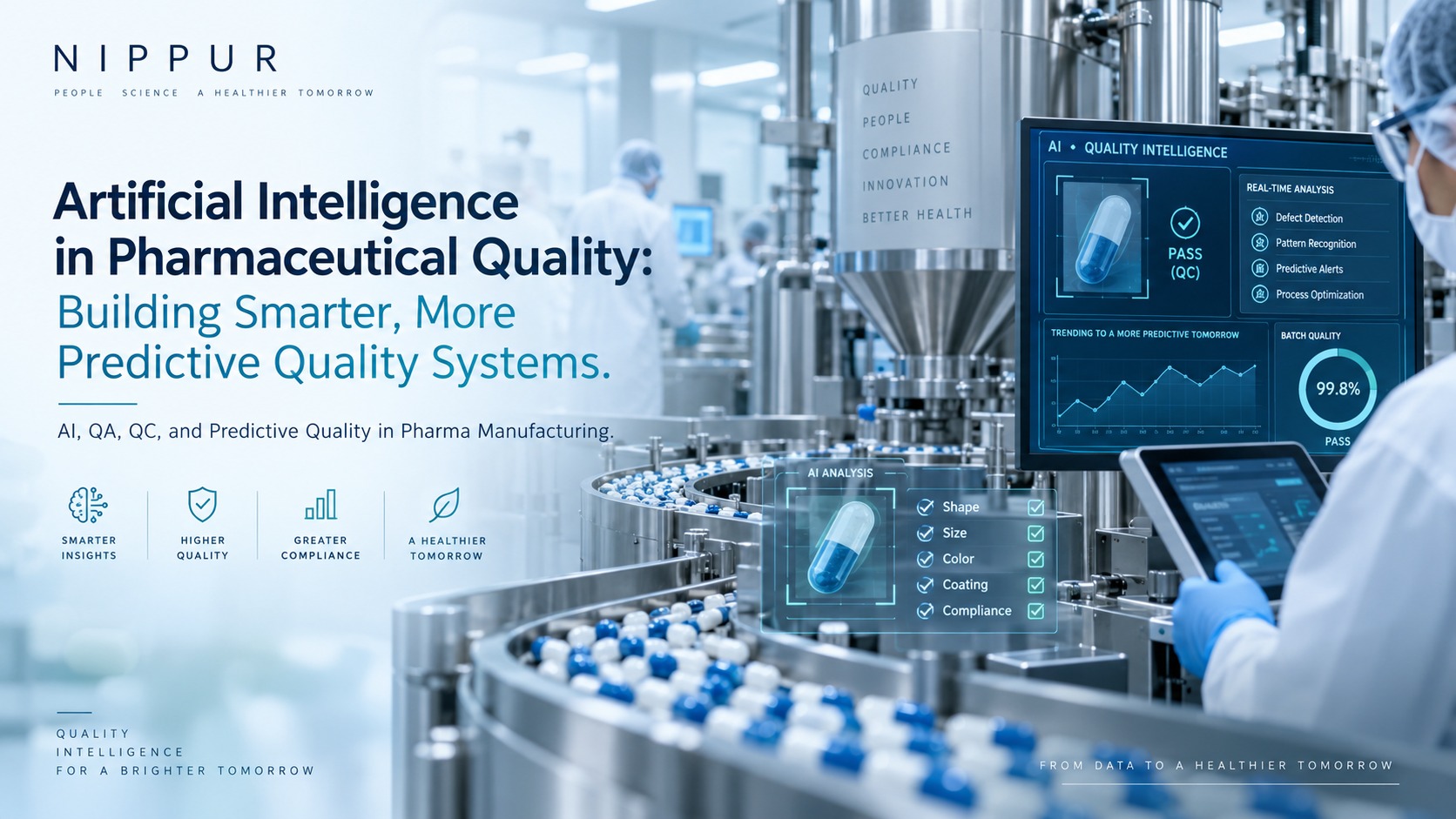
One of the most practical applications of AI in pharmaceutical QC is automated visual inspection.
AI-enabled computer vision systems can support the inspection of tablets, capsules, vials, ampoules, bottles, labels, and packaging. These systems may help identify defects such as cracks, discoloration, damaged products, visible particles, incorrect printing, or packaging inconsistencies.
AI-assisted inspection can improve consistency by applying the same assessment criteria across large production volumes, while allowing trained QC professionals to focus their attention on more complex or high-risk cases.
AI can also support the analysis of laboratory and manufacturing trends. By evaluating historical data, AI models may help identify unusual patterns that could indicate an emerging Out-of-Specification (OOS) or Out-of-Trend (OOT) condition.
From Reactive Quality to Predictive Quality
Traditional pharmaceutical quality systems are often designed around detecting, documenting, and investigating problems after they occur. AI introduces a different possibility: predictive quality.
Modern manufacturing processes generate continuous information about temperature, humidity, pressure, mixing speed, equipment performance, environmental conditions, and in-process test results.
Individually, these parameters may remain within acceptable ranges. However, several small changes occurring together may indicate that a process is moving toward a higher-risk condition.
By learning from historical manufacturing and quality data, AI systems can help recognize combinations of process conditions that have previously been associated with deviations, variability, or product-quality concerns.
Supporting Quality Assurance Teams
AI can also provide significant value within QA departments, where quality teams frequently work across large volumes of information from multiple systems.
- Deviation review
- CAPA analysis and prioritization
- Complaint trend analysis
- Quality risk management
- Change-control assessment
- Audit-trail review
- Document management
- Inspection readiness
- SOP and policy retrieval
During a deviation investigation, for example, an AI-assisted platform could help identify similar historical events and bring together relevant laboratory results, equipment history, maintenance records, batch information, and previous CAPAs.
The final investigation and quality decision must remain under qualified human oversight, but AI can make the process more efficient and better informed.
Generative AI and Quality Knowledge
Generative AI is also creating new opportunities for pharmaceutical quality organizations.
Companies maintain large collections of SOPs, policies, validation documents, training materials, investigation reports, and regulatory guidance. A controlled generative AI platform could help employees retrieve information from approved internal documents using natural-language questions.
Generative AI may also support document summarization, training preparation, investigation support, and knowledge management.
However, these applications require strong controls because AI-generated responses may sometimes be incomplete or inaccurate. Use in regulated environments therefore requires trusted data sources, validation, traceability, access control, and human verification.
AI, PAT, and Real-Time Process Understanding
AI can strengthen Process Analytical Technology (PAT) and real-time manufacturing monitoring.
PAT technologies provide continuous information about manufacturing processes through sensors, spectroscopy, and analytical tools. AI can help interpret these signals and connect them with Critical Process Parameters (CPPs) and Critical Quality Attributes (CQAs).
This can support continuous monitoring and, where scientifically justified and properly validated, Real-Time Release Testing (RTRT).
Human Expertise Remains Essential
AI should not be viewed as a replacement for pharmaceutical quality professionals.
Decisions involving batch disposition, deviation approval, CAPA effectiveness, validation, and regulatory compliance must remain scientifically justified and accountable.
The most appropriate role for AI is therefore decision support: identifying patterns, prioritizing information, providing early warnings, and helping professionals review complex data more efficiently.
Regulatory Readiness Matters
For pharmaceutical companies, adopting AI is not only a technology issue. It is also a quality and regulatory issue.
Any AI solution used in a GxP environment should be supported by appropriate controls for:
- Validation
- Data integrity
- Traceability
- Cybersecurity
- User access
- Documentation
- Performance monitoring
- Change management
- Human oversight
Data governance is particularly important. No AI system can deliver reliable conclusions if the underlying data is incomplete, inconsistent, or poorly controlled.
What This Means for Pharmaceutical Companies in Iraq and the Region
Across Iraq and the wider Middle East, pharmaceutical companies are increasingly investing in digital transformation, manufacturing modernization, quality systems, and regulatory readiness.
Successful AI adoption does not begin with purchasing an AI platform. It begins with identifying where the technology can create measurable value.
Priorities may include visual inspection, deviation management, laboratory trend analysis, predictive maintenance, complaint monitoring, or improved access to quality documentation.
From Quality Data to Quality Intelligence
Many pharmaceutical organizations already generate valuable information, but that information is often separated across manufacturing, laboratory, quality, maintenance, and commercial systems.
AI can help connect these data sources and identify relationships that may not be visible when each system is reviewed independently.
This is the transition from simply collecting quality data toward building quality intelligence.
Looking Ahead
The future of pharmaceutical quality will not be defined by AI alone. It will depend on how effectively organizations combine technology, pharmaceutical expertise, reliable data, strong governance, and regulatory understanding.
To achieve the full value of AI, manufacturers must also focus on capturing data directly from production equipment, sensors, laboratory systems, and factory operations and integrating it into connected digital platforms.
This data becomes the foundation for AI-driven monitoring, predictive maintenance, process optimization, and early detection of quality risks.
Data is often described as “the new oil” because its value appears only when it is properly collected, structured, connected, and used.
In pharmaceutical manufacturing, organizations that build strong data infrastructure today will be better positioned to benefit from AI tomorrow.
At Nippur, we believe that successful pharmaceutical transformation begins with understanding the business, regulatory, quality, and data environment before introducing technology.
AI should therefore be viewed not simply as another digital tool, but as part of a broader strategy to strengthen pharmaceutical operations, improve quality decision-making, and support sustainable industry development.
Need Technical Support or Quality Consultation?
Explore Nippur's specialized pharmaceutical consulting services and Nippur Academy training programs designed for pharmaceutical facilities and QA teams.
Contact Our ExpertsSubscribe to our Newsletter
Get the latest articles and updates delivered straight to your inbox.